Sitting in Cairo Airport, 3:20 am. Waiting for my flight to Sofia, Bulgaria for the 2008 Helms' Family Reunion. A rare occasion indeed. Quite possibly the last time we were all together was in the spring of 2006 when Eric and I finished undergrad.
It has been great to be back in Cairo. A different experience each time, with new memories, new impressions and new topics I am interested in learning more about.
Assuming Alitalia does not mess up my schedule again, I should be able to tromp around Rome for a few hours as well.
I'm certainly blessed to experience and see all that I have. I have made some great friends and seen some amazing things. Strangely, I'm actually a little excited to get back to school for my summer Arabic classes.

Over the last few weeks I have:
1. Visited Dahab in Sinai twice
2. Hung out in Cairo with my sister
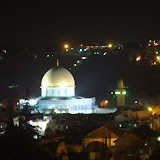
3. Visited Jerusalem for a grand total of 24 hours
The last few weeks have been a whirlwind of activity. My sister, Staci, visited me in Egypt for a week. It was her first time here, and considering she does not look like me everyone assumed we were dating. I don't know how many times I was called "Lucky man" as we walked the Cairo markets.
After showing her around Cairo for a few days, we caught an overnight bus to Dahab where we intended to spend three days relaxing on the beach. After a day however, we made the spontaneous decision to catch a bus to the border in order to visit Jerusalem the following day. So, after a two hour bus ride to the border, a quick Israel interrogation inquiring why I was carrying Arabic books in my bag, and a five hour bus ride from Eilat we arrived in Jerusalem.
Random observations from my 24 hours there:
1. Israel is fairly low-key, even a bit boring. Of course, I am coming from Cairo, which is like New York on crack, but the streets were generally empty after 9pm.
2. Israel is bloody expensive. One US dollar equals about 3.3 shekels... with small sandwiches easily costing 18 to 20 shekels.
3. (Jewish) Israelis really like Americans. We had some really pleasant conversations in our short time there with young Israelis on buses, around the city, and in restaurants. While sitting on the bus, an old man turned to Staci and told her that her boyfriend (me) is beautiful. It was a bit odd, but he said she was beautiful too.
4. Palestinian Israelis are fairly prevalent throughout Jerusalem, although we saw some being searched while walking throughout the Old City. Each one we talked to was dying to leave however, particularly the Christians in the Old City.
5. Israeli women are stunningly beautiful.
Staci left yesterday morning, and I have only a few more days left before returning to Sofia for the Helms' Reunion. Soon after I head back to DC and start summer classes. I've had a great time, although I'm missing some intellectual stimulation and am looking forward to taking classes again.
You can find more of my pictures from Jerusalem here:
 |
| Israel |
Last week I had the chance to return to one of my favorite placesin the world. Located on the Sinai peninsula, just an hour north of Sharm Al-Sheikh (where Bush is this week), the coast town of Dahab is a far cry from what one would traditionally expect to see in Egypt. Nearly naked Russian tourists wander around aimlessly drinking a bit too much, restaurants play Bob Marley and Jack Johnson, and the dogs are cuter and less abused than those in Cairo.
Last time I was in Dahab was in 2004 when I was studying abroad in Egypt for the first time. The town was half the size of what it is now, although it now stretches along the coast for about a half mile. Great restaurants with diwan seating line the coast and simple hostels provide guests with lodging in sleepy cottages. In 2005, Bedouin terrorists set off a few bombs here, which pissed off the Egyptians as they were the main victims. They also suffered economically, as tourism numbers have only slowly increased since then, and have yet to reach their pre-bombing numbers, as one hostel owner told me.
This time I went with my American friend Barrett, a Swedish friend Johannis, three Norwegians and a Scot. We lounged around on the beach for a few days, ate delicious food, smoked hookah, and just had a great time enjoying each other's presence.
The highlight of the week was watching the sunset in the evenings (I'll post pictures soon). The strong desert sun was setting over the cragged Sinai mountains as we swam in the crisp Red Sea water. The mountains of Saudi Arabia loomed in the distance across the sea and our beach was warm and deserted. It was absolutely beautiful, and reminded me of traveling previously when Topher, Carson, and I made a daily habit of beach, beer, and sunsets. It's a great way to wind down a hectic day.
I have less than two more weeks here in Egypt before a week in Bulgaria and then back to the States for summer classes. I have some more reflections to share on my experiences and Egypt in general, but I'll wait on those for another post.
Interesting article reflecting on the 60 years since Israel's creation and the implications of its existence.
Israel Won the Wars, Lost the Peace
By Mark Levine
On a flight home from a lecture at the University of Arizona on the eve of the Jewish holiday of Passover, I happened to sit next to an elderly woman whose accent, along with the Hebrew prayer card in her hand, suggested she was Israeli.
Our conversation during the flight epitomised the obstacles that continue to block a peaceful resolution to the Israeli-Palestinian conflict.
The woman was born in Poland and had lived through the Holocaust.
"Even 60 years later it's like a dream you can't believe," she explained when I asked her if she had still been in Poland when the war began.
"You arrive and they send you immediately to the showers; you never knew which shower it was - to clean you up or gas you."
After surviving Auschwitz, she was imprisoned in two more concentration camps, and then sent to a munitions factory in Germany later bombed by the Soviets.
"We were running through the streets alongside animals who escaped from the zoo next door when it was bombed. We were pulling the flesh off the burned animals because we were so hungry. It was like a barbecue."
Somehow, she managed to survive these horrors, as well as one of the infamous "death marches" that preceded the war's end, only to face a pogrom when she returned to her village in Poland in 1946. After these attacks, her remaining family fled Poland.
"Those who could, went to the United States, the rest went to Palestine."
Israel's collective identity
The woman's story is almost surreal in its horror. But such stories have been seared into Israel's collective identity. These memories are so powerful that even though few Israelis today lived through the Holocaust, they are a crucial reason why the possibility of peace with Palestinians remains so elusive.
It does not matter to the collective Israeli psyche that there has been a generation of peace with Egypt, a decade-and-a half with Jordan, and strong relations with Turkey and Morocco.
Nor does it matter that there is declared acceptance of Israel's existence by most Arab states. When the subject of the peace process inevitably came up in our conversation, my companion asked me incredulously: "Do you think they [Arabs] will just let us live?"
This psychology has not just made peace hard for Israelis to believe in, but by reinforcing the Israeli/Jewish sense of besiegement it has helped ensure the futility of Palestinian resistance - especially violent opposition - against the occupation.
It has also enabled the use of "security" considerations to justify an occupation which has had little to do with security, and everything to do with cementing Jewish control over as much of Israel's biblical heartland as possible.
Historical schizophrenia
But it is not only the collective memory of the Holocaust, along with the nature of Palestinian resistance to the occupation, that has helped produce a high level of fear and distrust in the Israeli psyche.
As important is the moral and historical schizophrenia which stem from the reality that Israel was born out of the displacement of 750,000 Palestinian Arabs.
It matters little that the overwhelming body of scholarship on the Palestinian refugee problem, much of it produced by Israeli scholars, accepts that Palestinians were made refugees by the deliberate actions of a Zionist/Israeli leadership.
Whether it was newly emptied Palestinian homes in Jaffa filled with Jewish refugees or national parks being established on the rubble of entire Galilee villages, the spectre of Palestine Lost so haunts Israel's national psyche that it takes an unceasing process of willful forgetting to ensure the continued erasure of Palestinians from the Israeli landscape.
Despite all its accomplishments, its military and economic might, superpower patronage, and acceptance across most of the region, Israel's sense of rootedness remains fragile.
So fragile, in fact, that to entertain the idea of culpability in the creation of the Palestinian refugee problem - the "original sin" that made Israel's establishment as an overwhelmingly Jewish majority state possible - would open a Pandora's box of self-doubt and recrimination that would threaten its viability as a "democratic Jewish state" today.
Israel's dilemma
Other settler colonial societies have faced similar dilemmas. But while the successful "extermination" of the native populations of the United States (to use historian Benny Morris's terminology) made possible an open and confident American nationalism, the ethnic cleansing of Palestine's non-Jewish population was never completed.
The continued presence of millions of Palestinians within and next to Israel has made it very hard for Israelis to feel confident in their control of the land.
Today, the non-Jewish population of mandate Palestine has achieved a rough parity with the Jewish population. Potentially more threatening to the Jewish identity of the state, according to some Israeli scholars, is that within a generation Palestinian citizens of Israel will come perilously close to outnumbering their Jewish compatriots.
If and when that moment arrives, Israel's existence as both a Jewish and democratic state will end.
Yet in a certain sense, the Jewish-but-democratic equation has always been a paradox imperfectly resolved. Even during the best of times, Israel has never been a fully democratic state, except for Jews of European descent.
Jews from Middle Eastern countries were excluded from the reins of political and economic power until relatively recently and have yet to achieve parity with Ashkenazis. Palestinian citizens lived under military rule until 1966; and though they have guaranteed equal political rights and can serve in the armed forces (which most Bedouin and Druze, but few Palestinians do), they remain legally and institutionally discriminated against.
Problematic democracy
This is no more evident than the crucial issues of access to land and public resources, while suffering regular surveillance and harassment by Israel's security services.
If Palestinian citizens do not live equally under the law, then Israel cannot accurately be referred to as the "Middle East's only Western-style democracy".
A more accurate description of Israel would be that it is an "ethnocracy," a formally democratic state where ethnicity and religion legally determine the degree of access to the full benefits of citizenship.
The "democracy" description becomes more problematic when the reality of Israel's de facto sovereignty over the Occupied Territories during the last 40 years is taken into account.
Since 1967, and even during the Oslo years (1993-2000), the Israeli government has controlled every major aspect of Palestinian life without granting the inhabitants of the West Bank and Gaza any political, civil, economic or cultural rights, effectively disenfranchising them for two generations.
One of the reasons for the failure of Oslo was that Israel retained almost full control over the Palestinian economy, borders, resources and security despite the establishment of a veneer of democracy with the Palestinian Authority and the Legislative Council.
The sheer inertia of the occupation's massive institutional and geographical infrastructure, coupled with the gnawing fear that even if peace were possible today Israel would remain vulnerable to the demographic time bomb tomorrow, helps explain why Israel intensified rather than dismantled the infrastructure of the occupation.
It doubled the settler population, widely expanding the area of Palestinian land under its control while continuing to destroy the foundations of Palestinian agriculture by seizing land, uprooting countless trees, and destroying thousands of homes.
In the minds of many Israeli leaders, peace was ultimately a mirage that would vanish into renewed existential conflict the moment it was reached.
Inseparable
None of this should come as a surprise to Israelis or analysts of the conflict. A generation ago, Israeli geographer Meron Benvenisti warned Israelis (in his widely publicised 1987 West Bank Data Base Project report) that Israel and the Occupied Territories were already too intertwined geographically, economically and economically to ever separate them again.
As important as Benvenisti's recognition of the depth of the Israeli occupation by the 1980s was his realisation that the goals of successive Israeli governments never included annexing the whole of the West Bank.
Rather, "the Israeli body-politic is precisely where it wants to stay. The present, fluid, amorphic situation is preferable and suits everybody. A better method than 'annexation' has been found to integrate and segregate at the same time: to integrate the territories for Israeli interests ... and segregate the Palestinian population to avoid any burdens (citizenship, extension of Israeli welfare system, free political expression)."
These are among the most prescient words ever written about the Israeli-Palestinian conflict, and they reveal that half a decade before Oslo, Israel had already achieved its primary objectives in the settlement process. Israeli leaders had found a formula to maintain permanent control over the desired areas of the West Bank without fomenting overwhelming Palestinian opposition.
But if Israel's negotiating strategy during Oslo mirrored the older strategy of drawing out negotiations until facts on the ground made Palestinian independence on any terms but Israel's impossible, the reality is that in winning the war, Israel lost its chance for peace.
Viable Palestinian state?
The minimum requirements for establishing a viable Palestinian state - dismantling most of the settlement infrastructure to allow territorial contiguity in the West Bank (including East Jerusalem), full Palestinian control over their economy, and (at the very least) an honest accounting of Israel's role in the creation of the Palestinian refugee problem - can no longer be met.
Quite simply, doing so would entail a far higher political, social and economic cost than would the continuation of the occupation, with its manageable level of violence.
This reality has cast a pall over the community of Israeli and Palestinian scholars who have devoted much of the last two decades trying to envision scenarios for a peaceful resolution to the conflict.
A little over five years ago, at the height of the al-Aqsa intifada, most of my colleagues on both sides of the Green Line remained convinced that a two-state solution was the only viable solution to the conflict, even as many supported the principle of a bi-national state.
Today, the consensus is clearly that conditions for a two-state solution no longer exist. But at the same time a workable binational option seems equally implausible to envision in the near future.
"Maybe in 50-60 years," one Palestinian colleague mused when I spoke to him recently; precisely when the demographic balance is tipped far in the Palestinians' favour.
Imagining new scenarios
For sure, the fraying of the multi-ethnic and religious fabrics of Lebanon and Iraq do not offer much hope for a shared Israel/Palestine.
Yet despite the odds, Palestinian and Israeli activists and scholars continue to imagine new scenarios for achieving peace, justice and democracy for both peoples.
Fifteen years after Shimon Peres announced the birth of a "New Middle East," in which national borders and identities would matter less than cultural capital and economic ingenuity, perhaps the best anyone can hope for is what Israeli geographer Oren Yiftachel describes as a "gradual binationalism".
This would then open up the space between the two and one-state solutions through a "reintegration of Israel-Palestine" - psychologically, as much as politically.
"Of course, this is an (almost) illusionary vision," Yiftachel is the first to admit. "I am not optimistic, but I feel it is important to continue and air options that people can imagine, and not succumb to the gloom and doom path of 'creeping apartheid' in which we are walking."
If the emerging generation of Israelis and Palestinians can begin to think outside the nationalist and religious framework that has doomed older generations to perpetual conflict, the vision of Yiftachel and his Israeli and Palestinian comrades could take root before the sheer weight of the occupation erodes whatever glimmer of hope for peaceful coexistence remains.
It is undoubtedly a long shot, but the alternative is violence on a scale that can no longer be managed by either side, with catastrophic results for Israel, Palestine, and the Middle East as a whole.
Mark LeVine is professor of history at the University of California Irvine and author or editor of half a dozen books dealing with the Israeli-Palestinian conflict and globalisation in the Middle East. He is also a contributing editor for Tikkun magazine.
It's hard to believe, but I'm writing this blog from a coffee shop in Cairo, Egypt. I arrived yesterday morning at 2:30 am to a reception and waiting car of a couple Egyptian friends, an American friend, and a Swedish friend. It was quite the multicultural reception back to Egypt.
I caught my flight from Washington, DC the evening of the 29th. After a quick transfer through Vienna, I met up with my brother in downtown Sofia in Bulgaria. He graciously traveled from his village to meet me in the capital. We had a whirlwind 24 hours together of viewing old Greek Orthodox churches, eating some great Bulgarian food, visiting a few bars along the way, and watching a Champions League match before my jet-lagged delirium set in and I went to bed. It was great to see my bro again, as it has been over a year since I saw him last.
I caught my flight to Cairo the next day. I was supposed to have a nice layover in Rome - long enough to explore the city and see some sites. Unfortunately, Alitalia failed to tell me that they had changed my flight from 1pm to 8pm, so rather than spending a beautiful day on the steps of the Vatican, I was stuck drinking bitter Nescafe in the Sofia airport. Let me tell you, if you drink enough Nescafe, you will become very familiar with Bulgarian toilets and their lack of toilet seats...
Being back in Cairo is almost surreal. I've walked all over my old neighborhood, met up with a great deal of old friends, went to a couple of my favorite cafes, rode a felucca on the Nile, and somehow managed to write half of my term paper which I didn't finish before leaving DC... all that in about 35 hours.
It's good to be back.
Subscribe to:
Posts (Atom)
